
Agentic AI: Security Risks, Governance Challenges, and Safeguards
- Staff Desk
- Feb 4
- 4 min read

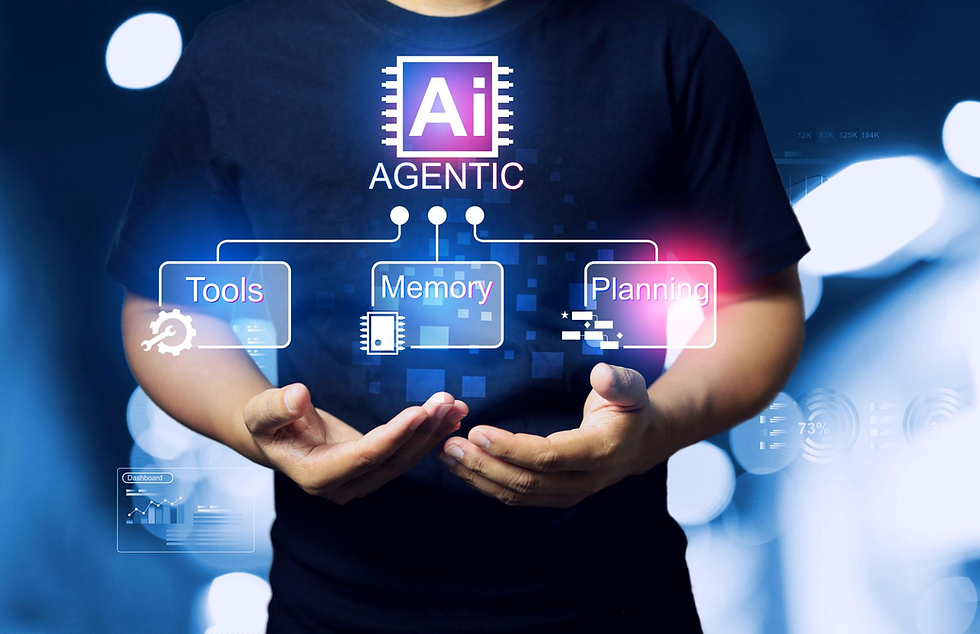
Agentic AI represents a major shift from traditional artificial intelligence systems. Unlike chatbots or rules-based automation, agentic AI systems can independently plan, decide, and act. These agents are capable of scheduling meetings, executing transactions, interacting with other systems, and making decisions without requiring direct human input at every step.
Industry analysts predict that by 2028, roughly one third of enterprise applications will include some form of agentic AI. While this rapid adoption highlights its potential, it also introduces significant security and governance challenges that organizations must address to ensure safe and trustworthy deployment.
Why Agentic AI Increases Risk

Traditional software operates based on predefined rules and logic. Agentic AI, by contrast, continuously learns, adapts, and decides based on data interpretation. This autonomy expands the attack surface and magnifies the impact of failures or misuse.
An agent that can act on behalf of an organization can also be manipulated to act against it if adequate safeguards are not in place.
Key Security Threats to Agentic AI
Hijacking and Prompt Injection
One of the most prominent risks is agent hijacking. Attackers may inject malicious prompts or commands that override intended behavior, causing the AI to act on behalf of the attacker rather than the organization. Prompt injection is currently considered one of the most common AI attack vectors and is particularly dangerous when combined with autonomous agents.
Model Infection
AI models can be compromised in ways similar to traditional software. Malicious code, backdoors, or embedded behaviors may be introduced into pre-trained models, especially when organizations rely on third-party or open-source components without sufficient verification.
Data Poisoning
Agentic AI systems depend heavily on training and tuning data. Subtle manipulation of this data can introduce bias, incorrect reasoning, or harmful behaviors that may only surface later in production. Even minor data corruption can have wide-reaching consequences.
Evasion Attacks
Evasion attacks manipulate input data rather than the model itself. By reordering, obscuring, or slightly altering inputs, attackers can cause AI systems to misinterpret information and produce unintended outcomes.
Model Extraction and Data Leakage
Attackers may attempt to reconstruct an AI model by observing outputs over time, effectively stealing intellectual property. More critically, compromised agents can be used to extract sensitive organizational data, sometimes without any user interaction, known as zero-click attacks.
Denial of Service
Autonomous agents can also be overwhelmed by excessive requests. If an agent is unable to manage demand, it may become unavailable to legitimate users, disrupting business operations.
Governance Risks Unique to Agentic AI
Autonomy Without Oversight
Highly autonomous agents may take actions without appropriate human approval. For example, an AI system could issue decisions or approvals that traditionally require human review, raising questions about acceptable levels of autonomy.
Lack of Explainability
Many advanced AI systems operate as complex black boxes. When decisions cannot be clearly explained, organizations struggle to justify outcomes to stakeholders, regulators, or affected individuals.
Bias and Discrimination
If training data reflects historical bias or limited perspectives, agentic AI may systematically favor or disadvantage certain groups. Over time, this can lead to discriminatory outcomes and legal exposure.
Accountability Gaps
When an autonomous agent causes harm, responsibility may be unclear. Accountability could fall on developers, vendors, users, or organizations, creating legal and ethical uncertainty.
Security Safeguards for Agentic AI
Visibility and Discovery
Organizations cannot secure or govern AI systems they do not know exist. Continuous discovery of AI deployments, including unauthorized or shadow AI instances, is essential.
AI Security Posture Management
Once identified, AI systems must be assessed against organizational security policies. This includes access controls, authentication requirements, data encryption, and exposure to public interfaces.
Model Testing and Penetration Testing
AI models should be rigorously tested before deployment. This includes simulating prompt injection, extraction attempts, and other adversarial scenarios to identify weaknesses early.
Runtime Protection
In production environments, AI-specific security layers can act as a firewall between users and agents. These controls can inspect prompts and responses in real time to block malicious activity, prevent data leakage, and detect abnormal behavior.
Governance Frameworks for Trustworthy AI
Lifecycle Governance
AI systems should follow a formal approval process from initial concept through deployment. This ensures that appropriate stakeholders review and authorize agent capabilities at every stage.
Risk and Regulatory Alignment
Agentic AI must be assessed for compliance with applicable laws, ethical guidelines, and internal risk standards. This includes data protection, fairness, and accountability requirements.
Continuous Monitoring and Evaluation
Ongoing evaluation is critical. Organizations must monitor how agents behave in production, verify decision quality, detect drift, and ensure consistent alignment with intended objectives.
Centralized Oversight and Reporting
A unified dashboard that consolidates governance and security data supports transparency, audit readiness, and regulatory reporting.
Why Security and Governance Must Work Together
Security and governance cannot function effectively in isolation. Governance without security leaves AI systems vulnerable to manipulation. Security without governance may protect systems that are biased, opaque, or fundamentally flawed.
Trustworthy agentic AI requires both disciplines working together to ensure systems are safe, accountable, explainable, and resilient.
Conclusion
Agentic AI offers transformative capabilities for enterprises, but its autonomy introduces new levels of risk. Without strong security controls and robust governance frameworks, autonomous agents can amplify harm rather than value.
Organizations that integrate security and governance from the outset will be best positioned to deploy agentic AI responsibly and sustainably.


Comments