
AI-Powered Domestic Robots: The Future of Smart Home Technology Is Closer Than You Think
- Jayant Upadhyaya
- Feb 11
- 5 min read

Artificial intelligence is no longer limited to chatbots, recommendation engines, or self-driving cars. The next major leap in AI and technology is happening inside the home. Companies across the world are racing to build AI-powered domestic robots designed to clean, tidy, fold laundry, and assist with everyday tasks.
Billions of dollars are being invested into this new fze that home robotics could become the next big consumer revolution. But how close are we to a truly autonomous robot butler?
Let’s explore the current state of AI-driven home robots, the technology behind them, and what it will take for this innovation to become mainstream.
The Rise of AI in Domestic Robotics

AI has evolved rapidly in digital spaces. Generative AI models can write, design, and analyze. Machine learning systems power logistics, finance, and customer service. Now, that intelligence is moving into physical machines.
Domestic robots are designed to operate in dynamic, unpredictable environments. Unlike factory robots, which work in controlled settings, home robots must navigate:
Furniture that moves
Different lighting conditions
Children and pets
Fragile objects
Changing room layouts
This requires a combination of advanced AI, computer vision, machine learning, and robotics engineering.
The goal is simple in theory: create a robot that understands its environment, makes decisions independently, and safely performs household tasks. In practice, this is one of the hardest challenges in modern technology.
How AI Is Training Domestic Helper Robots
The core engine behind modern home robotics is artificial intelligence. But AI models need training data. Unlike language models that learn from internet text, robots need physical-world data.
There is no global “internet of household movement.” So robotics companies are building it from scratch.
Teleoperation-Based Learning
One popular approach involves teleoperation. A human operator wears a motion-tracking suit or VR headset and controls the robot remotely. The robot records every movement.
Over time, AI systems learn patterns such as:
How to grip objects
How much force to apply
How to navigate around obstacles
How to adjust movements when something shifts
This data is used to train neural networks that eventually allow the robot to operate more independently.
Wearable Data Collection
Another innovative approach uses sensor-equipped gloves. People perform normal tasks in their homes while cameras and motion trackers record their actions.
This method allows companies to gather diverse data from hundreds of homes. The more varied the data, the better the AI system can generalize to new environments.
Real-World Deployment for Continuous Learning
Some robotics firms deploy robots into real-world settings, such as laundromats or test homes, to perform repetitive tasks like folding laundry.
Each repetition improves performance. Over weeks and months, robots become faster and more accurate.
Deployment is a critical strategy. AI in robotics improves significantly when exposed to unpredictable, real-world conditions rather than lab simulations.
What Can AI-Powered Home Robots Do Today?
The most advanced domestic robots can already:
Clear tables
Fold laundry
Water plants
Wipe surfaces
Open doors
Make simple drinks
However, full autonomy remains limited. In many demonstrations, robots require occasional resets or remote supervision. Some tasks still depend on human intervention when unexpected problems arise.
Despite this, the progress is impressive. Compared to robotics capabilities just a few years ago, today’s systems show significant advancements in perception, manipulation, and movement.
The Role of AI Software in Robotics
Not all companies are building robot hardware. Some focus entirely on AI software.
The idea is to create a general-purpose AI system capable of controlling different types of robots, whether humanoid machines or appliance-style devices.
This mirrors the evolution of AI in digital products. Just as foundational AI models power many applications today, robotics software platforms aim to become the “intelligence layer” for physical machines. If successful, this could accelerate innovation across the entire robotics industry.
Safety: The Most Critical Factor
AI-powered domestic robots must operate in homes with children, elderly individuals, and pets. Safety is non-negotiable.
Companies are investing heavily in:
Collision detection systems
Slow, controlled motion planning
Emergency stop mechanisms
Force-limiting joint designs
Unlike software errors, physical mistakes can cause real damage. This is why robotics development moves cautiously. Safety standards will determine how quickly these robots gain consumer trust.
Privacy in the Age of AI Home Assistants

AI-powered home robots rely on cameras and sensors to understand their surroundings. This raises legitimate privacy concerns.
If robots require:
Remote teleoperation
Cloud-based processing
Continuous video monitoring
Then companies must address data protection carefully.
Consumers will demand:
Transparent privacy policies
Encrypted data storage
Local processing options
Clear user controls
Trust will be essential for widespread adoption.
The Economics of AI Domestic Robots
Early versions of home robots are expensive, often priced in the tens of thousands.
This means early adopters are likely to be:
Technology enthusiasts
High-income households
Early innovation supporters
However, many compare the current stage of robotics to the early days of smartphones or electric vehicles. As manufacturing scales and AI improves, costs are expected to decrease.
Companies envision a future where AI home robots become as common as washing machines or dishwashers.
The Global Race in Robotics Innovation
The push for AI-driven domestic robots is global.
Silicon Valley startups are aggressively innovating. European companies are advancing humanoid robotics designs. Chinese firms are scaling hardware production rapidly.
Governments are monitoring the sector closely. In some regions, officials have warned about potential market bubbles due to rapid investment.
The competition is intense. Companies are protective of their intellectual property, aware that whoever achieves reliable autonomy first could dominate a massive market.
Why Domestic Robotics Is Harder Than Digital AI
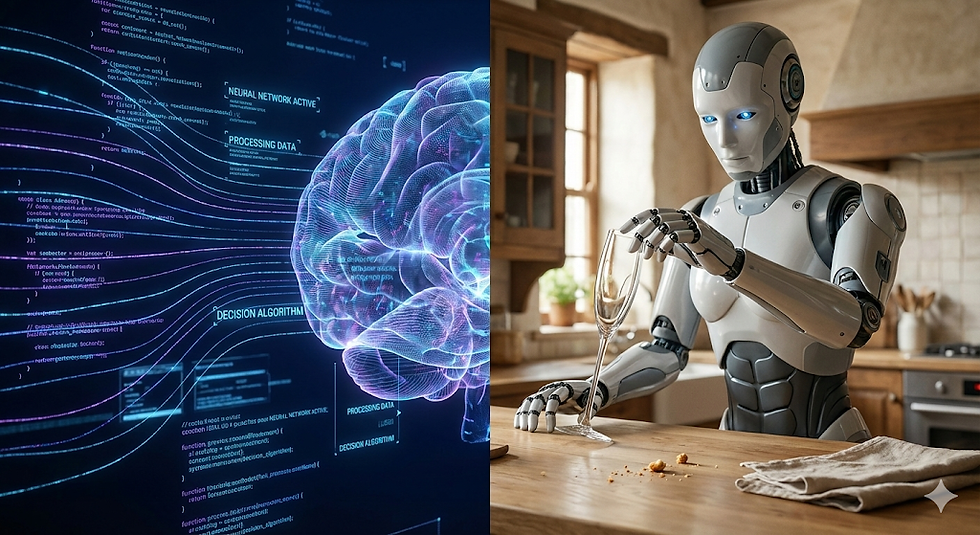
Training a chatbot is fundamentally different from training a robot.
Language models operate in virtual environments. If they make mistakes, the impact is limited to text errors.
Robots operate in physical environments where:
Objects break
People get injured
Real-world unpredictability exists
For domestic robots to succeed, they must combine:
Computer vision
Real-time decision-making
Precision motor control
Context awareness
Safety compliance
This is a far more complex challenge than generating text or images.
When Will AI Robots Become Normal in Homes?
Industry experts are divided. Some believe it could take 15 to 20 years before domestic robots become truly useful and widely accepted. Others argue that technological breakthroughs often appear suddenly after years of incremental progress.
Driverless cars were once considered distant science fiction. Now, they operate in multiple cities worldwide. Smartphones evolved rapidly once hardware and software reached critical milestones. Domestic robotics may follow a similar path.
The Long-Term Vision for AI in Smart Homes
Despite challenges, the long-term vision remains powerful.
AI-powered home robots could:
Reduce repetitive household labor
Support aging populations
Improve accessibility for people with disabilities
Free up time for families
Increase productivity at home
As AI continues to evolve, integration between smart home systems and robotics will likely deepen.
Robots may coordinate with:
Smart appliances
Voice assistants
Home security systems
IoT devices
The future of smart homes may not just be connected devices, but embodied intelligence moving within the space.
Final Thoughts: Is the Robot Butler Here Yet?
Not quite. AI-powered domestic robots are advancing rapidly, but they are still in early stages of development. Autonomy is improving. Data collection is expanding. Investment is accelerating.
The foundation for the future of home robotics is being built today. Whether widespread adoption happens in five years or twenty, one thing is clear:
Artificial intelligence is moving from screens into physical spaces. The era of AI-driven domestic technology has begun. The robot butler may not be fully ready yet, but the race to bring it into our homes is well underway.


Comments