
Beyond the AI Hype: How Organizations Can Turn AI Into Real Business Value

Artificial intelligence has become one of the most talked-about technologies in business today. From generative AI tools to AI agents, the excitement is everywhere. Many organizations are investing heavily, hoping AI will improve productivity, cut costs, and transform how work gets done.
But after the hype, a serious question remains: how do organizations actually get value from AI?
This article explores where AI truly stands today, the challenges organizations face when adopting it, and how leaders can make better decisions about AI now and in the future.
1. Understanding the AI Hype Cycle
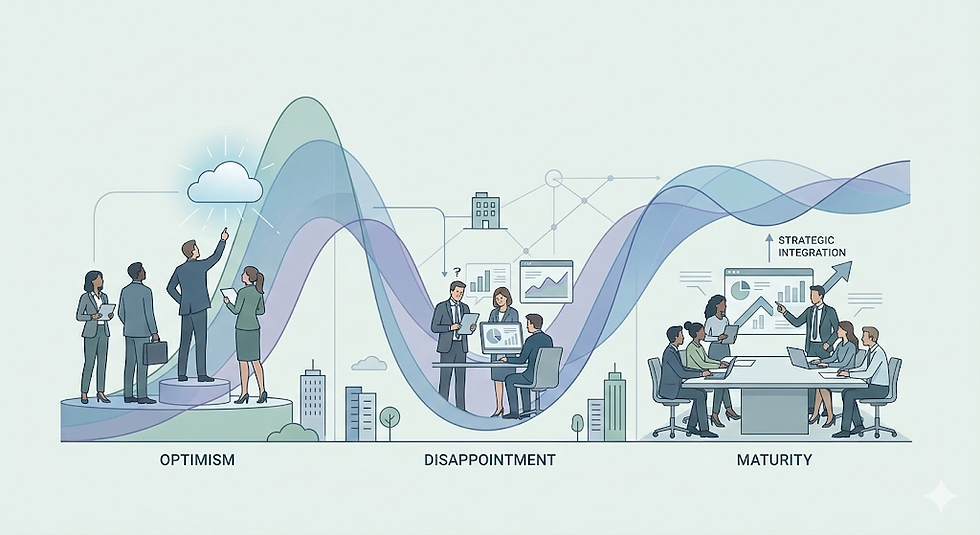
When people talk about AI hype, they often imagine it as one single trend. In reality, AI is made up of many different technologies and capabilities, all moving at different speeds.
Some parts of AI, such as foundational models and early generative AI tools, are entering what analysts call the Trough of Disillusionment. This is the phase where expectations were high, but real-world results have not always matched the excitement.
At the same time, other parts of AI, such as agentic AI, are climbing toward the Peak of Inflated Expectations, where optimism is once again very strong.
And then there are areas of AI that are already becoming mature and productive, quietly delivering value without much hype.
The key point is this: AI is not one single thing. It is a collection of capabilities, each at a different stage of maturity.
2. Why AI Feels Confusing to Leaders
Many executives feel frustrated because AI seems to change its story every year. One moment, AI is described as something ready for immediate impact. The next moment, it is described as a future vision that still needs work.
This confusion is natural. AI has been around for decades. The term itself was coined in the late 1950s. What changed recently is the arrival of generative AI, which brought AI back into the spotlight in a very visible way.
Since then, new capabilities keep emerging. Each wave brings new promises, new tools, and new expectations. This makes AI feel like a moving target.
Different organizations also see AI differently depending on where they are in their journey. A company just starting with AI will see it very differently from one that has been experimenting for years.
3. AI as the “Elephant” Problem
A useful way to think about AI is through an old story about several blind people touching an elephant. One touches the tail and thinks it is a rope. Another touches the side and thinks it is a wall. Each person believes their experience explains the whole animal.
AI is similar. Different teams touch different parts of AI and assume that is all AI is. One team sees chatbots. Another sees automation. Another sees analytics. None of them are wrong, but none of them are seeing the full picture.
This is why alignment across leadership is so important. AI must be understood as a composite of many capabilities, not a single solution.
4. The Biggest Challenge: Doing AI for the Right Reason
One of the most common mistakes organizations make is adopting AI because they feel they have to. This often comes from fear of missing out.
Leaders say, “We need AI,” but cannot clearly explain why or for what problem.
When AI is introduced without a clear purpose, employees are left to figure it out on their own. Some will succeed, but most will struggle.
A small group of employees will always experiment and find creative uses. However, the majority of the workforce needs guidance. They do their best work when tools are clearly connected to their daily workflows.
5. Why One AI Tool Does Not Fit Everyone

AI capabilities are powerful, but they are also generic by default. For example, AI can summarize text very well. But how that summary is used depends entirely on the role.
A recruiter needs summaries of resumes
A procurement officer needs summaries of contracts
A marketer needs summaries of campaign data
If everyone is given the same AI tool without context, the value will remain limited.
This is why organizations must put a wrapper around AI. That wrapper can include people, processes, or technology. The goal is to make AI feel relevant and useful for each role without forcing employees to design solutions themselves.
6. AI as a Companion, Not a Replacement
One of the healthiest ways to think about AI is as a companion to the human workforce.
AI should:
Support decision-making
Reduce repetitive work
Improve speed and quality
It should not be introduced as a mysterious replacement for human roles.
When AI is framed as a helpful partner, adoption improves and fear decreases.
7. Breaking Organizational Silos
AI adoption often fails because it is treated as a technology project instead of an organizational change.
The cost of AI tools is often small compared to the cost of change management. Training, communication, process redesign, and governance can cost much more than the technology itself.
To break silos, organizations must:
Improve AI literacy
Encourage participation from employees
Address fears openly
Build trust through transparency
AI should feel like something employees help shape, not something imposed on them.
8. The Role of Governance and Ethics
Many people are worried about AI because they have heard stories about bias, hallucinations, and incorrect outputs.
These concerns are valid. Ignoring them slows adoption.
Strong governance helps organizations:
Set rules for AI use
Monitor risks
Ensure fairness and accountability
Governance is not a blocker. It is an enabler. It allows organizations to scale AI responsibly.
9. The Biggest Misconception About AI Value
One of the most common misconceptions is the belief that AI will deliver value immediately.
People expect instant return on investment because AI tools respond instantly. But business value does not work that way.
AI value is a journey, not a switch.
The real impact comes when AI is embedded into workflows, measured with the right metrics, and improved over time.
10. Three Types of AI Use Cases
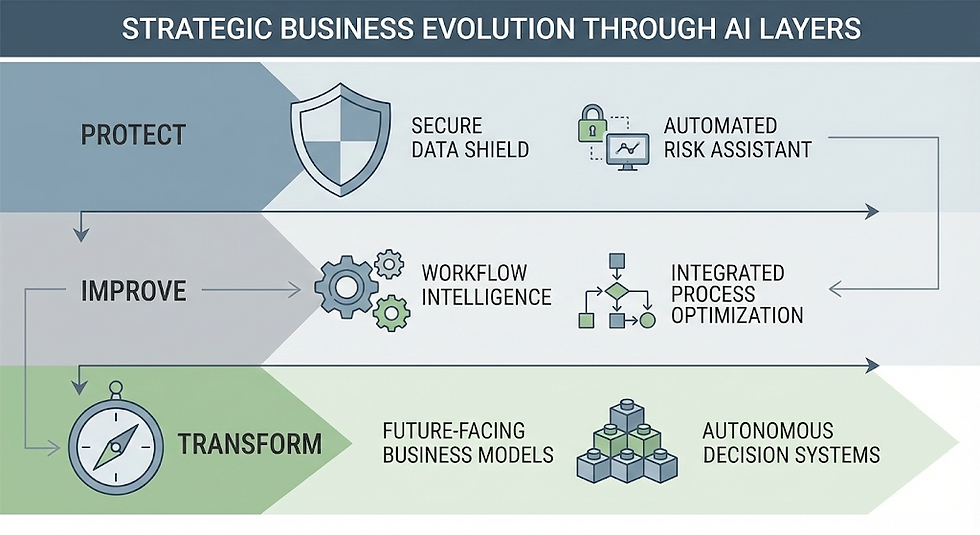
AI use cases generally fall into three categories:
Defend Use Cases
These focus on general tools like chat assistants. They improve satisfaction and comfort but rarely deliver direct financial returns.
Extend Use Cases
These embed AI into existing workflows. Here, AI improves efficiency, speed, and quality. This is where organizations start seeing measurable value.
Upend Use Cases
These are bold bets on the future. They aim to transform business models but are hard to measure and risky.
A healthy AI strategy includes all three, but leaders must be realistic about timelines and expectations.
11. Why ROI Takes Time
AI systems depend on many components working together:
Data quality
Processes
People
Technology
If one part is weak, the entire system suffers.
Even if one AI feature works well, poor integration elsewhere can prevent real impact. That is why patience and continuous improvement are essential.
12. Thinking About the Future Without Freezing Today
Many leaders hesitate because they fear making the wrong decision. With AI evolving so fast, it is tempting to wait for the next big thing.
This creates paralysis.
The best approach is to be future-aware but present-focused.
Decisions should be based on:
Today’s business priorities
Current constraints
Existing systems
Waiting indefinitely only delays learning and value creation.
13. Balancing Past, Present, and Future
Organizations cannot ignore their legacy systems. Years of investment cannot be erased overnight.
AI must work with existing technology, not pretend it does not exist.
A strong strategy:
Respects past investments
Solves present problems
Prepares for future evolution
This balanced approach reduces risk and builds confidence.
14. Are AI Agents the Future?
AI agents have helped people understand AI better by giving it a more human-like form. This has improved adoption.
However, AI agents do not replace roles. They perform tasks within roles.
This distinction is important. Over-anthropomorphizing AI creates unrealistic expectations and confusion.
15. Agents Are a Phase, Not the End State

AI agents are an important step in AI’s evolution, but they are not the final destination.
In the future, intelligence may be:
Embedded directly into models
Built into systems and networks
Invisible but pervasive
For now, agents will remain useful for the next few years, but organizations should not assume they are the final form of AI.
16. How AI Changes Perception
One major impact of AI agents is psychological. They make AI feel more relatable and easier to imagine.
This shift helps people move from seeing AI as a tool to seeing it as a collaborator. While helpful, this framing must be managed carefully to avoid unrealistic expectations.
17. Long-Term Predictions for AI in the Enterprise
Over the next five years and beyond:
AI will become less visible but more embedded
The focus will shift from tools to outcomes
Governance and trust will matter more than novelty
AI success will depend less on choosing the “best” tool and more on how well organizations integrate AI into everyday work.
18. What Success Really Looks Like
Successful AI adoption looks like:
Employees using AI naturally in their workflows
Leaders measuring value realistically
Systems improving steadily over time
AI becoming boring in the best way possible
When AI stops being a headline and starts being a habit, real value has been achieved.
Final Thoughts
AI is not magic, and it is not a failure. It is a powerful technology that requires thoughtful implementation.
The organizations that succeed will be those that:
Move beyond hype
Focus on people and processes
Invest in change management
Stay grounded while looking ahead
AI is a journey. Those who walk it patiently and strategically will see the greatest rewards.


Comments