
From Demo to Production: Designing Reliable Retrieval-Augmented Generation (RAG) Systems

Large language models (LLMs) are powerful tools for reasoning, summarization, and natural language interaction. However, they have a fundamental limitation: they do not have access to private or proprietary data.
They are trained on public sources and frozen at training time. They cannot natively read internal documents, company policies, databases, or proprietary knowledge.
Retrieval-Augmented Generation (RAG) was introduced to solve this limitation. At a conceptual level, RAG allows a system to retrieve relevant information from private data sources and inject that information into the model’s prompt at inference time.
This enables LLMs to produce responses grounded in organization-specific knowledge without retraining the model.
While RAG works well in controlled demonstrations, many systems fail when deployed in real-world environments. The difference between a demo-grade RAG system and a production-ready one is substantial.
This article dissects the architecture of a production-grade RAG system, explains where simple implementations fail, and outlines the components required to build systems that remain reliable under real-world conditions.
The Core RAG Concept
At its simplest, RAG follows a three-step process:
Retrieve - A user submits a query. The system retrieves relevant information from a document store or knowledge base.
Augment - The retrieved information is added to the user’s query to form an augmented prompt.
Generate - The augmented prompt is passed to the LLM, which generates a response grounded in the provided context.
This workflow is sometimes summarized as:
Retrieve → Augment → Generate
The appeal of RAG lies in its simplicity. It avoids retraining models, does not require large computational budgets, and can be implemented with relatively lightweight infrastructure. However, this simplicity hides significant pitfalls.
Why Naive RAG Fails in Production

In controlled environments, RAG systems often work because:
Documents are clean and well-structured
Questions are predictable
Data is up-to-date
Context is complete and unambiguous
In production, none of these assumptions reliably hold.
Common Failure Scenarios
Outdated Information - A system retrieves a policy document from an earlier revision without understanding version history.
Incomplete Context -A document chunk contains part of a rule but omits eligibility criteria or exceptions.
Broken Structure- Tables, lists, and formatted data degrade into incoherent text after extraction.
Ambiguous Retrieval - A query matches multiple documents that mention similar terms but differ in meaning or applicability.
False Confidence - LLMs rarely respond with “I don’t know.” When provided with weak or misleading context, they often hallucinate answers that sound correct but are factually wrong.
Research has shown that poor retrieval can lead to worse hallucinations than providing no context at all. This makes naive RAG systems dangerous in production settings.
The Production RAG Mindset
A production-grade RAG system must be designed around a core principle:
Context quality matters more than model intelligence. The system must actively preserve meaning, validate outputs, and measure performance.
This requires moving beyond a single retrieval step and introducing structure, planning, validation, and evaluation.
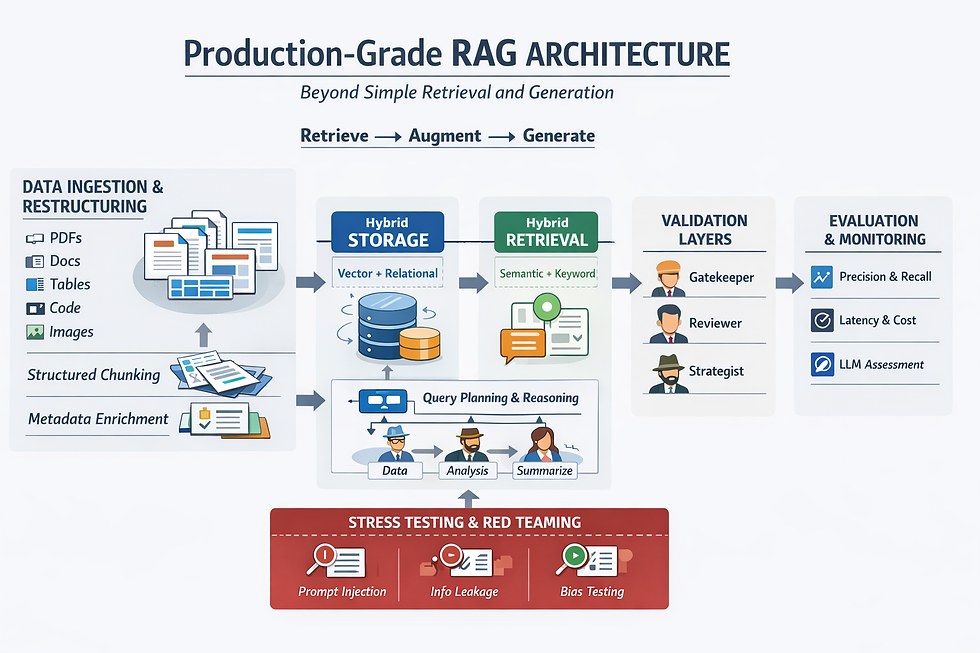
Production RAG Architecture Overview
A robust RAG system consists of the following major layers:
Data ingestion and restructuring
Structure-aware chunking
Metadata enrichment
Hybrid storage (vector + relational)
Hybrid retrieval (semantic + keyword)
Query planning and reasoning
Multi-agent coordination
Output validation
Evaluation and monitoring
Stress testing and red teaming
Each layer addresses a specific failure mode commonly observed in real-world deployments.
Data Ingestion and Restructuring
The Problem with Raw Documents
Enterprise data rarely arrives in clean, uniform formats. Common issues include:
PDFs with multi-column layouts
Tables embedded in text
Headers and footers repeated on every page
HTML navigation elements mixed with content
Word documents with inconsistent formatting
Blindly splitting raw text into chunks destroys structure and meaning.
Restructuring as the First Step
Production systems introduce a document restructuring layer.
This layer analyzes the document and identifies:
Headings and subheadings
Paragraph boundaries
Tables and lists
Code blocks
Footnotes and references
The goal is to preserve semantic structure before chunking occurs. Structure is not decoration; it encodes meaning.
Structure-Aware Chunking

Why Fixed Token Chunking Fails
Many tutorials suggest splitting documents into fixed token windows (e.g., 500 tokens).
This approach:
Splits tables in half
Separates headings from their content
Breaks logical units mid-sentence
Loses semantic cohesion
Structure-Aware Chunking Strategy
Instead of chunking by size alone, production systems chunk by logical boundaries.
Such as:
A heading with its associated paragraphs
An entire table as a single unit
A complete code block
A full policy rule with conditions and exceptions
Typical chunk sizes range from 250 to 512 tokens, often with controlled overlap. The exact number is less important than respecting document structure.
Metadata Enrichment
In production systems, text alone is insufficient.
For each chunk, additional metadata is generated, including:
A concise summary
Extracted keywords
Document identifiers
Version numbers and timestamps
Hypothetical questions the chunk can answer
Hypothetical Question Generation
Generating questions that a chunk could answer significantly improves retrieval quality. Instead of matching queries against arbitrary text, the system matches user questions to semantically aligned question representations.
This reduces false positives and improves recall for complex queries.
Storage: Beyond Vector Databases
The Limits of Vector-Only Storage
Vector similarity search excels at semantic matching but struggles with:
Version filtering
Date constraints
Document grouping
Policy precedence
Regulatory scope
Production systems often require combining semantic similarity with structured filtering.
Hybrid Storage Model
A production-grade RAG system uses a database that supports:
Vector embeddings for semantic search
Relational data for filtering, joins, and version control
This enables queries such as:
“Find the most recent policy applicable to California”
“Exclude deprecated documents”
“Merge all sections from the same source”
Hybrid Retrieval: Semantic + Keyword Search
Why Semantic Search Alone Is Insufficient
Vector embeddings may miss:
Exact product names
Error codes
Legal references
Acronyms
Numerical identifiers
Hybrid Retrieval Strategy
Production systems combine:
Semantic search for conceptual similarity
Keyword search for exact matches
Results are reranked based on relevance signals from both approaches. This hybrid model significantly improves retrieval accuracy.
Query Planning and Reasoning

The Limitation of Single-Step Queries
Many user questions cannot be answered with a single retrieval operation. For example:
“Compare Q3 performance in Europe and Asia and recommend which region to prioritize next quarter.”
This requires:
Multiple data sources
Comparative analysis
Synthesis and reasoning
Planner-Based Reasoning Engine
A planner analyzes the query and determines:
What information is required
Which tools or data sources to use
The sequence of steps needed
The system then executes the plan before generating a final response.
Multi-Agent Coordination
Agent Specialization
In advanced systems, different agents specialize in tasks such as:
Data retrieval
Summarization
Numerical analysis
Policy interpretation
Each agent operates independently on its subtask. Results are combined into a final answer.
This agentic approach enables scalable reasoning over complex queries.
Validation Before Response Delivery
Why Validation Is Critical
As system complexity increases, so does the risk of error. Confident but incorrect responses are unacceptable in production.
Validation Layers
Production systems route outputs through validation nodes such as:
Gatekeeper: Ensures the answer addresses the original question
Reviewer: Verifies claims are grounded in retrieved context
Strategist: Checks logical consistency and completeness
These layers emulate human self-checking before responding.
Evaluation and Monitoring
Quantitative Evaluation
Metrics include:
Retrieval precision and recall
Context relevance
Coverage of required information
Qualitative Evaluation
LLM-based evaluators assess:
Faithfulness to sources
Depth and clarity
Alignment with user intent
Performance Evaluation
Operational metrics include:
Latency
Token usage
Cost per request
Without continuous evaluation, system degradation goes unnoticed.
Stress Testing and Red Teaming

Before deployment, systems must be deliberately tested for failure modes, including:
Prompt injection
Information leakage
Bias amplification
Adversarial phrasing
Overconfidence under uncertainty
Stress testing reveals weaknesses before users encounter them.
Final Architecture Summary
A production-ready RAG system includes:
Structured data ingestion
Structure-aware chunking
Metadata-rich indexing
Hybrid vector and relational storage
Hybrid semantic and keyword retrieval
Query planning and reasoning
Multi-agent execution
Output validation
Continuous evaluation
Stress testing and red teaming
This architecture moves far beyond simple retrieval and generation. It reflects what is known about LLM behavior, failure modes, and operational realities.
Conclusion
Retrieval-Augmented Generation is not a single technique but an evolving system architecture. While basic implementations can work in demonstrations, production environments demand rigor, structure, validation, and continuous measurement.
The difference between a demo RAG system and a production RAG system is not incremental. It is architectural. Building reliable AI systems requires acknowledging that retrieval quality, structure preservation, and validation matter as much as the language model itself.
Only by addressing these dimensions can RAG systems deliver accurate, trustworthy, and scalable results in real-world applications.


Comments