
Robotics for Jewelry: How Automation is Transforming Precision Craftsmanship

A fine ring can fail by a fraction of a millimeter. A prong that sits too high catches on fabric. A channel that is slightly uneven makes stones look dull. A wax model with soft edges can turn a clean design into a muddy casting.
Jewelry has always rewarded steady hands, sharp eyes, and patience. It also asks makers to repeat tiny moves with near-perfect consistency. That is where automation is changing the workshop. Robots, computer-controlled mills, laser systems, machine vision, and small collaborative arms are taking on tasks that demand repeatability while skilled jewelers stay focused on design choices, finishing judgment, and the feel of a piece.
This shift is not replacing craftsmanship. It is changing where craftsmanship lives. The bench is becoming a place where hand skill, digital design, and precise machines work together.

Jewelry is a natural fit for precise automation
Jewelry looks delicate, but the work behind it is technical. A maker has to manage geometry, surface quality, shrinkage, hardness, heat, stone fit, and balance. Small errors show quickly because the objects are worn up close.
Traditional tools already carry a long history of controlled motion. The lathe, drawplate, rolling mill, flex shaft, engraving machine, and polishing motor all extend the hand. Robotics for jewelry builds on that same idea. It gives the maker another way to guide force, angle, speed, and repetition.
Several traits make jewelry especially suited to automation.
The scale is small
Most jewelry parts fit within compact machines. A ring, pendant, clasp, or setting can be held in a fixture and worked from several angles. Smaller work areas make robotic systems easier to contain and safer to run.
The tolerances are tight
Stone seats, prong positions, hinge pins, and pavé layouts all depend on accuracy. A robot or CNC system can repeat a tool path with consistency that is hard to match by hand over dozens or hundreds of pieces.
The designs are data-rich
Many modern pieces start as CAD files. Once a design exists as a digital model, it can guide milling, printing, inspection, engraving, and documentation. The file becomes part of the craft process.
The materials are valuable
Gold, platinum, and fine stones leave little room for waste. Automated cutting, controlled deposition, and repeatable polishing can reduce scrap and rework when the process is well set up.
Customization is growing
Many buyers want personal details, vintage-inspired forms, unusual stone layouts, or one-of-one pieces. Automation helps shops move from digital concept to physical sample faster, while still allowing hand finishing and custom adjustments.
A useful way to view robotics in jewelry is simple: machines handle the motion that benefits from repeatability, while people handle taste, interpretation, problem-solving, and final touch.
That split matters. A ring may be milled by a machine, cast by a technician, cleaned by hand, set by a jeweler, inspected under magnification, and polished with both powered tools and hand compounds. The result is not purely automated or purely handmade. It is a chain of choices.
Robots are changing the core steps of jewelry production
Automation does not appear in one single place. It touches the work from design development to final inspection. Some systems look like classic industrial robots. Others look like compact bench tools with computer control. In practice, both belong to the same larger movement toward controlled, repeatable making.
Digital design creates the path
Most automated work begins with a CAD model. A designer builds the ring, pendant, bracelet link, or setting in software, then checks scale, wall thickness, stone size, undercuts, and assembly.
The CAD file can guide:
Wax or resin model production
Direct metal printing
CNC milling
Laser engraving
Stone layout mapping
Quality checks after casting or machining
This does not make design automatic. CAD only follows the decisions put into it. A designer still needs to know how metal behaves, where to leave strength, how a ring feels between fingers, and how light moves across a surface.
A good CAD model for jewelry is not just pretty on a screen. It has to survive making and wearing.
CNC milling produces crisp models and metal parts
Computer numerical control, known as CNC, has become common in jewelry production. A mill follows digital tool paths to cut wax, resin, or metal. In wax, it can create models for casting. In metal, it can cut bezels, signet faces, bracelet elements, and flat components with high accuracy.
Milling is especially helpful for:
Symmetrical forms
Repeated motifs
Sharp lettering
Coin-like relief work
Parts that must fit together tightly
Clean stone seats in certain settings
CNC milling has limits. It struggles with some undercuts, tool access, and very organic textures. The cutter has a physical size, so it cannot reach every inner corner. That is why many pieces still need hand refinement after machining.
3D printing expands design freedom
Additive manufacturing has had a huge effect on jewelry. Many workshops use resin printers to make castable models. The printed model is invested, burned out, and cast in metal. Some manufacturers also use direct metal printing for selected designs, though it requires careful finishing and equipment.
Printing is useful when a design has:
Complex lattice details
Interlocking shapes
Sculptural forms
Repeating surfaces
Fine prototypes for approval
A printed model still demands skill. Supports must be placed carefully. Resin must be cured and cleaned. Casting behavior must be understood. Surface prep often decides whether the finished piece looks refined or rough.
Laser systems make small joins and marks cleaner
Laser welding has become a trusted tool in many jewelry shops. It allows a jeweler to apply heat in a narrow area, often near stones or delicate details where a torch would spread too much heat. While a laser welder is not always a robot in the classic sense, automated and semi-automated laser systems are part of the same change.
Lasers can help with:
Repairing porosity
Adding metal to worn prongs
Joining small components
Tack-welding assemblies before soldering
Creating clean engraved marks
Personalizing names, dates, and patterns
Automated laser engraving also gives shops a repeatable way to add serial numbers, maker marks, decorative patterns, and text. A hand engraver brings depth, character, and artistry. A laser brings exact repetition and speed.
Robotic handling improves repeated tasks
Small robotic arms can move pieces between stations, hold tools, or present parts for inspection. In high-volume settings, they may load blanks, place components, apply compounds, or guide parts through finishing steps.
These systems work best when the task is predictable. A robot can repeat a motion all day. It does not get tired during a run of identical bracelet links. It also does not make creative choices unless a human has defined the rules.
That is why fixtures are so important. Before a robot can work on small jewelry parts, the shop must hold each piece in a stable and repeatable position. Poor fixturing ruins good automation.

Jewelry task | How automation helps | Where hand skill still matters |
Wax modeling | Repeats clean tool paths and geometry | Adjusting proportions and correcting design issues |
Stone seat cutting | Places seats with even spacing and depth | Final fit, tightening, and visual alignment |
Engraving | Repeats text, marks, and patterns | Artistic engraving and expressive line work |
Polishing prep | Covers repeated surfaces with consistent motion | Final luster, edge protection, and judgment |
Inspection | Measures geometry and flags differences | Deciding whether a variation is acceptable |
Assembly | Holds, presents, or joins small parts | Choosing sequence and solving fit problems |
Precision improves when machines and jewelers share the work
Automation changes the feel of production because it moves certain decisions earlier. A jeweler once solved many problems at the bench after rough parts arrived. Now many of those choices happen in the CAD model, the fixture, the tool library, and the machine setup.
That can improve quality, but only when the shop understands the whole process.
Repeatability makes collections more consistent
A single handmade piece can have charm because of small variations. A collection needs another standard. If a brand sells the same ring design in multiple sizes and metals, customers expect the style to remain recognizable. The shoulders should curve the same way. The stones should sit at the same height. The profile should feel consistent.
Automation helps maintain that continuity. A digital model can be adjusted for size while keeping key design features intact. Tool paths can be reused. Inspection data can reveal where casting or finishing changes the part.
Consistency matters even for custom jewelry. When a client approves a rendering or sample, the final piece should match the promise.
Machine vision helps catch tiny defects
Machine vision uses cameras and software to inspect parts. In jewelry, it can help check positions, surfaces, outlines, engraving, and stone placement. It is not a replacement for a trained eye, but it can flag issues early.
For example, an inspection system may compare a cast part to a digital reference. It can detect whether a prong is too short, whether a hole is blocked, or whether a milled seat is out of position. On repeated production runs, this helps shops catch drift before a full batch needs rework.
Human inspection still matters because jewelry has visual and tactile qualities that are hard to reduce to measurements. A mirror polish, a soft edge, a comfortable inside profile, and a graceful transition need judgment.
Automated stone setting is growing, but it is selective
Stone setting is one of the most skill-heavy areas of jewelry. The setter must secure the stone without damage, manage pressure, and make the finished setting look clean from every angle.
Automation can help with specific parts of this work. Machines can drill, cut seats, map layouts, or assist with bead and channel preparation. Some systems can place stones in repeated settings under controlled conditions.
The best uses are often in high-repeat work, such as pavé fields, watch components, or calibrated stones in regular patterns. Irregular stones, heirloom repairs, fragile gems, and expressive one-of-a-kind settings still demand human control.
This is a good example of the larger pattern. Automation prepares the conditions for excellence. The jeweler completes the work with touch and judgment.
Polishing becomes more controlled
Polishing looks simple from the outside. It is not. Too much pressure can soften details, round edges, thin prongs, or blur engraving. Too little leaves scratches behind. Different metals respond differently to compounds, wheels, speeds, and heat.
Robotic polishing can help keep pressure and motion consistent. For repeated pieces, this can reduce uneven surfaces and protect geometry. Tumbling and mass finishing also play a role, especially for small components before final hand polish.
Still, the final finish often remains a human task. A jeweler knows which edge must stay crisp, which surface should glow rather than shine like a mirror, and where a tool could catch.

The strongest results usually come from a hybrid workflow: digital control for repeatable geometry, hand work for beauty, feel, and final approval.
Automation changes the craft, but it does not erase it
Concerns about automation in jewelry are real. Jewelry carries emotion. It marks engagements, anniversaries, grief, milestones, identity, faith, and family memory. Buyers often care about the human story behind a piece.
This is why the conversation should not reduce everything to speed. A faster ring is not automatically a better ring. A cleaner casting is not automatically a meaningful design. A perfectly repeated pattern can still feel lifeless if the proportions are wrong.
Automation gives makers new control, but it also demands new skill.
The bench jeweler becomes a digital craftsperson
The modern jeweler may still saw, file, solder, set, and polish. They may also review meshes, prepare print supports, adjust a milling strategy, calibrate a laser, or design a fixture.
That mix creates a broader craft identity. The hand does not disappear. It moves between physical tools and digital ones.
A skilled maker working with automation must understand:
How much metal a casting will need after cleanup
How prong thickness changes during polishing
Which areas need extra support during printing
What tool marks will show after plating or finishing
How stones vary even when nominal sizes match
How to design for repair, not just for production
These are craft questions, not just software questions.
Design choices can become more ambitious
Automation opens paths that are difficult or slow by hand. Fine repeating patterns, complex inner structures, hidden galleries, precise modular parts, and sculptural surfaces become easier to test.
A designer can prototype several versions of a ring shank, change the height of a setting, print samples, and check comfort before committing to metal. This kind of iteration can lead to better pieces because decisions are tested physically, not just imagined.
The danger is overdesign. CAD makes it easy to add details that look impressive on a screen but weaken the piece or feel uncomfortable. Good jewelry design still needs restraint. It needs respect for wear, cleaning, resizing, repair, and daily contact with skin and fabric.
Small shops can compete in new ways
Automation used to belong mainly to large manufacturers. That has changed. Many small studios now use CAD, resin printing, laser welding, digital scanning, and outsourced milling or casting. They may not own every machine, but they can build a flexible production chain.
This lets independent makers offer custom work with more predictable previews and cleaner revisions. A client can see a realistic model. The jeweler can test ring proportions. The shop can remake a lost earring from scan data or match a missing pattern with digital tools.
Access still has limits. Machines cost money. Training takes time. Maintenance matters. Poor automation can create expensive mistakes. A low-quality print, a bad support strategy, or a careless CAD model can waste metal and labor.
The advantage goes to jewelers who treat technology as part of the craft, not a shortcut around it.
Heritage skills gain a new role
Hand engraving, wax carving, chasing, repoussé, filigree, stone setting, granulation, and forging still have value. In some areas, their value may grow because they stand out more clearly against machine-made uniformity.
A hand-engraved line carries pressure changes and rhythm. A carved wax may hold the maker’s gesture. A hand-forged band can have a life that no model library can copy.
Automation does not make these methods obsolete. It gives jewelers a choice. Some pieces need perfect repetition. Others need the slight irregularity that signals touch. Many need both.
The hard parts are materials, setup, and trust
The promise of automation is easy to describe. The work of making it reliable is harder.
Jewelry materials create serious challenges. Precious metals differ in hardness, spring, heat behavior, and castability. Stones vary in size, shape, cleavage, heat sensitivity, and surface condition. A process that works for sterling silver may not work the same way for platinum. A setting that holds a calibrated diamond may not suit an opal, emerald, or antique-cut stone.
Automation thrives on known inputs. Jewelry often brings variation.
Fixturing decides accuracy
A robot can move accurately and still miss the target if the part shifts. Jewelry parts are small, reflective, and often irregular. Holding them without marking the surface requires care.
Good fixtures must:
Secure the piece without damage
Allow tool access
Repeat the same position
Support fragile areas
Survive heat, vibration, or polishing force when needed
For one-off work, complex fixturing may not make sense. For repeated work, it can be the difference between success and frustration.
Surface finish can reveal every shortcut
A machine can produce consistent geometry, but jewelry still needs beautiful surfaces. Layer lines from printing, tool marks from milling, pits from casting, or uneven polishing will show under bright light.
This is where process planning matters. The maker has to think backward from the desired finish. If a ring needs crisp milgrain and polished shoulders, the file must allow enough metal for finishing. If a pendant has deep recesses, the shop needs a plan for cleaning and polishing those areas before casting or after.
Finishing is not an afterthought. It is part of design.
Data has to match reality
A CAD model may say a stone is 4 mm. The actual stone may be slightly different. A scanner may capture a worn heirloom ring, but the model still needs interpretation. A machine may cut a seat to the file, but casting shrinkage or cleanup may change the fit.
Good shops build feedback loops. They compare finished pieces with the digital model. They adjust files based on casting results. They keep notes on materials and vendors. They do not assume the screen is the truth.
Ethical sourcing and repair still need human decisions
Automation can improve traceability when paired with good records, but it does not answer ethical questions by itself. A shop still has to choose suppliers, understand material origins where possible, and communicate honestly with clients.
The same applies to repair. A robot can help rebuild a worn prong or scan a damaged ring. A jeweler must decide whether repair is safe, whether a stone should be removed first, whether old solder joints can handle heat, and whether sentimental value changes the best approach.
Trust remains human.
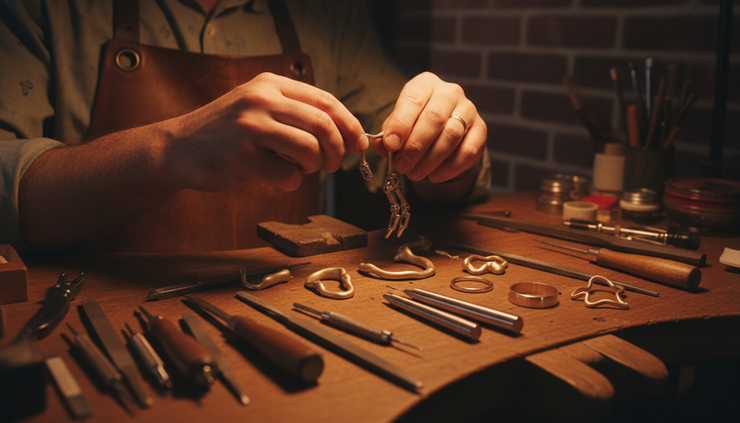
The future of jewelry making will be hybrid
The next stage of automation in jewelry will likely be less about replacing the bench and more about connecting tools into smoother systems. A design may move from scan to CAD to printed model to casting to inspection with fewer manual conversions. A shop may store data for a custom ring so it can make a matching band years later. A repair studio may scan a worn vintage piece before any work begins, preserving a record of its original condition.
Several developments are likely to shape the field.
More accessible collaborative robots
Smaller, safer robotic arms can support workshops that do not look like factories. They can handle repetitive motions, hold parts, or assist with polishing and inspection. Their value will depend on simple setup and reliable fixtures.
Better machine vision for reflective surfaces
Jewelry is hard to inspect because polished metal reflects everything around it. Better lighting, cameras, and software will improve measurement and defect detection. Human review will still be needed, but machines can help catch repeat issues sooner.
Smarter design checks
CAD tools will keep improving at warning designers about thin walls, weak prongs, stone fit problems, casting risks, and comfort issues. These checks will help less experienced users, but they will not replace material knowledge.
More mixed production methods
A single piece may combine printed castings, milled details, hand-fabricated components, laser work, and hand setting. The best method will depend on the design, metal, stones, budget, and purpose.
Greater demand for transparency
As automation grows, buyers may ask clearer questions. Was the design hand carved, CAD modeled, printed, cast, hand engraved, machine engraved, or assembled from stock parts? Honest answers can build value rather than reduce it. Many clients appreciate knowing how a piece was made when the explanation is clear.
The future jeweler will not be defined by one tool. They will be defined by judgment. The best makers will know when to let a machine repeat a perfect motion and when to pick up a file, graver, torch, or loupe.
Automation can make jewelry more precise. It can reduce waste, improve consistency, and make complex designs practical. It can help small studios prototype faster and help large makers keep quality steady. Yet the heart of fine jewelry still rests on proportion, wearability, finish, and meaning.
A robot can cut a clean seat. It can polish with steady pressure. It can inspect a shape against a model. It cannot decide whether a ring feels graceful, whether a detail honors the stone, or whether the finished piece carries the emotion it should.
That is the real transformation. Precision craftsmanship is no longer only hand versus machine. It is the careful partnership between both, guided by makers who understand metal, stones, tools, and the people who will wear the work.


Comments