
The Rise of Agentic AI: Opportunities, Risks, and the Need for Observability

Every few decades, technology undergoes a transformation so fundamental that it reshapes how businesses operate, how value is created, and how work itself is defined. The transition from desktop computing to mobile, from on-premise infrastructure to cloud computing, and from rule-based automation to data-driven systems each marked such inflection points.
Artificial Intelligence (AI), particularly agentic AI, represents the next seismic shift. Unlike earlier AI systems that were limited to narrow tasks or predictive analytics, modern AI agents can reason, act, interact with systems, and execute multi-step workflows autonomously. These systems are no longer just tools; they are becoming participants in business processes.
As enterprises deploy tens, hundreds, or even thousands of AI agents across functions—marketing, customer service, finance, operations, and engineering—the promise is immense. Productivity increases, cost reductions, faster decision-making, and new business models all appear within reach.
Yet, with this promise comes a new class of risks. AI agents are probabilistic, non-deterministic systems. They can fail silently, hallucinate incorrect outputs, expose sensitive data, or generate runaway costs. Managing this balance between innovation and control is one of the defining challenges of modern enterprise technology.
This article explores the rise of agentic AI, its applications across industries, the emerging risks, and why observability, governance, and control are becoming foundational requirements for sustainable AI adoption.
Understanding Agentic AI

What Are AI Agents?
AI agents are systems capable of perceiving their environment, reasoning about goals, and taking actions to achieve specific outcomes. Unlike traditional software, which follows predefined rules, AI agents rely on large language models (LLMs) and machine learning to make decisions dynamically.
Key characteristics of AI agents include:
Autonomy: They can act without constant human intervention
Context awareness: They retain and reason over conversational or operational context
Goal orientation: They pursue objectives rather than execute static instructions
Adaptability: They can modify behavior based on feedback or new information
These traits make AI agents powerful—but also difficult to predict.
The Explosion of Agentic Workflows
From Single Models to Multi-Agent Systems
Early AI deployments focused on single models performing narrow tasks: sentiment analysis, fraud detection, or recommendation engines. Today, enterprises are building agentic workflows, where multiple agents collaborate across tasks.
Examples include:
A customer service agent that triages tickets
A retrieval agent that pulls data from internal systems
A reasoning agent that determines next steps
An execution agent that performs actions like refunds or database updates
Each agent may rely on one or more foundation models, external APIs, and internal business logic.
Scale Is Increasing Rapidly
Some organizations already report deploying dozens or hundreds of agents, with projections reaching thousands. As adoption accelerates, agentic systems begin to resemble distributed software ecosystems rather than isolated applications.
This scale introduces complexity that traditional monitoring and governance tools were never designed to handle.
Industry Applications of Agentic AI
1. Software Development and Engineering
AI-assisted coding tools have dramatically reduced development time. Tasks that once took weeks—such as writing boilerplate code, refactoring systems, or debugging—can now be accomplished in minutes.
Developers increasingly rely on AI agents for:
Code generation
Code review
Test creation
Documentation
Infrastructure configuration
This has shifted the role of engineers from writing every line of code to supervising, validating, and integrating AI-generated output.
2. Customer Service and Support
Customer service is one of the earliest large-scale beneficiaries of agentic AI.
AI agents now:
Handle customer queries autonomously
Escalate complex cases to humans
Summarize conversations
Provide real-time suggestions to human agents
The result is faster response times and lower operational costs. However, failures—such as incorrect responses or hallucinated policies—can directly impact customer trust.
3. Financial Services and Insurance
In banking and insurance, AI agents are used for:
Claims processing
Underwriting assistance
Fraud detection
Risk assessment
Compliance checks
These applications are high-stakes. Errors can lead to regulatory violations, financial losses, or legal consequences. As a result, trust, explainability, and governance are critical.
4. Marketing and Advertising
In digital advertising, businesses spend a significant portion of revenue experimenting with creatives, targeting, and budgets.
AI agents are increasingly used to:
Generate ad creatives
Predict performance
Optimize spend allocation
Automate campaign management
The promise is reduced experimentation costs and improved return on investment. However, inaccurate predictions or biased optimization strategies can quickly lead to wasted spend.
The Core Problem: Non-Deterministic Systems
Why AI Fails Differently Than Traditional Software
Traditional software fails loudly. A server crashes, an API times out, or an error code is thrown. Engineers can trace logs and reproduce the issue.
AI systems fail silently.
An AI agent may:
Provide an incorrect answer with high confidence
Take an action that appears reasonable but is wrong
Loop endlessly, increasing costs
Produce biased or non-compliant outputs
Because LLMs are probabilistic, the same input does not always produce the same output. This makes debugging and root-cause analysis significantly harder.
Hallucinations: A Persistent Challenge
AI hallucinations occur when models generate outputs that are factually incorrect or unsupported by evidence.
In enterprise contexts, hallucinations can lead to:
Incorrect financial decisions
Legal disputes
Reputational damage
Operational failures
Unlike simple bugs, hallucinations may go unnoticed unless explicitly monitored and validated.
Security Risks in Agentic AI
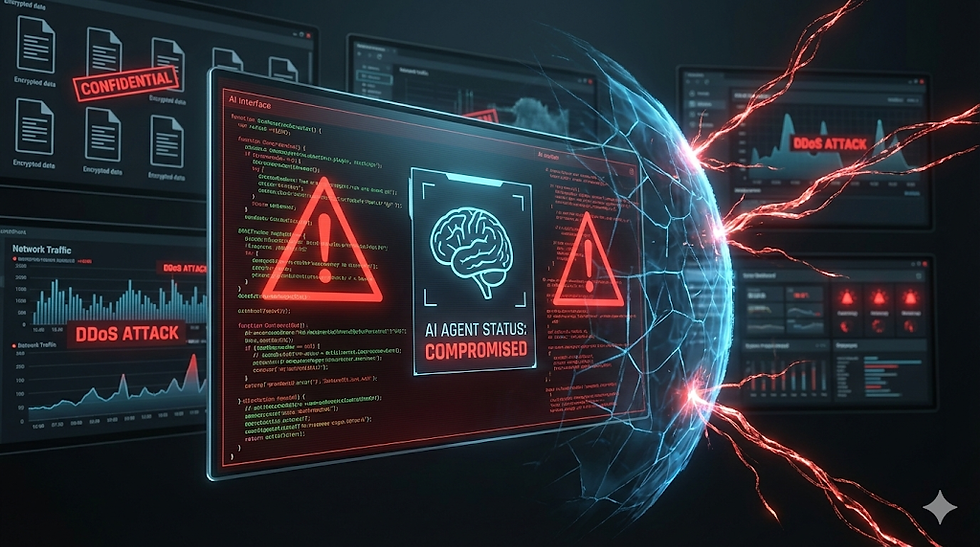
Prompt Injection Attacks
Prompt injection is a form of attack where malicious input manipulates an AI agent into revealing sensitive information or performing unauthorized actions.
Examples include:
Overriding system instructions
Extracting internal prompts
Triggering unintended workflows
As agents gain access to internal systems, the attack surface expands significantly.
Data Leakage and PII Exposure
AI agents often process sensitive data, including:
Customer information
Financial records
Health data
Proprietary business knowledge
Without proper safeguards, agents may inadvertently expose personally identifiable information (PII) or confidential data in responses.
Cost Management: The Hidden Risk
Runaway LLM Costs
Foundation models are not cheap. Each request incurs a cost, and agentic systems may make multiple calls per task.
Cost risks include:
Infinite loops between agents
Excessive retries
Overly verbose outputs
Inefficient prompt design
Without visibility into usage patterns, organizations may face unexpected cost spikes.
Observability: Lessons from the Cloud Era
A Parallel from Infrastructure Monitoring
Before observability tools, engineers struggled to understand system behavior in distributed environments. Failures were difficult to trace, and costs were poorly understood.
Observability transformed infrastructure management by providing:
Metrics
Logs
Traces
Alerts
AI systems now face a similar moment.
What Does AI Observability Mean?
AI observability extends traditional monitoring concepts to machine learning and agentic systems.
It involves:
Tracing agent decisions and interactions
Monitoring model inputs and outputs
Measuring accuracy, relevance, and consistency
Detecting hallucinations and anomalies
Tracking cost and performance metrics
Without observability, AI becomes a black box.
Governance and Control: Beyond Monitoring
Why Monitoring Alone Is Not Enough
Knowing that something went wrong is insufficient. Enterprises need mechanisms to:
Intervene in real time
Enforce policies
Block unsafe outputs
Roll back actions
This requires a control plane for AI systems.
The Three Primary Enterprise Concerns

Surveys of enterprise leaders consistently highlight three dominant concerns regarding AI agents:
1. Security
Ensuring agents are protected against attacks and data leaks.
2. Trust
Guaranteeing outputs are reliable, explainable, and aligned with business objectives.
3. Cost
Preventing uncontrolled usage and financial overruns.
Any successful AI strategy must address all three simultaneously.
Building Trustworthy AI Systems
Trust in AI is not blind faith. It is earned through:
Transparency
Validation
Accountability
Continuous monitoring
Enterprises must treat AI systems as evolving entities that require ongoing oversight, not one-time deployments.
Human Oversight Remains Essential
Despite advances in autonomy, humans remain critical:
To define goals and constraints
To audit decisions
To intervene during failures
To update policies and models
AI augments human capability; it does not replace responsibility.
The Role of Guardrails
Guardrails are constraints that prevent AI systems from exceeding acceptable boundaries.
Examples include:
Content filters
Access controls
Confidence thresholds
Approval workflows
Well-designed guardrails enable innovation without sacrificing safety.
Optimism with Caution
Technological progress has always carried risk. What differentiates successful transformations is not the absence of risk, but the ability to manage it.
AI’s transformative potential is undeniable:
Increased productivity
New business models
Improved customer experiences
Faster innovation cycles
At the same time, unmanaged AI can create systemic vulnerabilities.
The Future of Agentic AI
Looking ahead, several trends are likely:
Increased adoption of multi-agent systems
Greater regulatory scrutiny
Standardization of observability practices
Integration of AI governance into enterprise architecture
Organizations that invest early in trust, control, and visibility will be better positioned to scale AI responsibly.
Conclusion
Agentic AI marks a turning point in enterprise technology. It moves AI from passive analysis to active participation in workflows. This shift unlocks enormous value—but also introduces new risks that traditional systems were never designed to handle.
Observability, governance, and cost control are no longer optional add-ons. They are foundational requirements for deploying AI at scale. The challenge is not whether AI will transform industries—it already is.
The real question is whether organizations can harness its power responsibly, ensuring that innovation works for them and not against them. The future belongs to those who approach AI with optimism, tempered by vigilance, and guided by thoughtful design.


Comments