
Top AI Music Generator Online Tools in 2026: A Practical Guide for Creators


Artificial intelligence is transforming how music is produced. In the past, composing a song required instruments, recording equipment, and sometimes years of musical training. Today, an AI Music Generator Online can help anyone turn ideas into complete tracks within minutes.
Whether you’re a content creator, marketer, indie developer, or hobbyist musician, modern AI Song Generator platforms provide a fast way to generate background music, experiment with genres, or prototype melodies.
In this guide, we’ll explore five notable platforms that allow users to create AI-generated music online. Each offers a slightly different workflow and target audience.
1. MakeSong

Overview
Among the growing number of music-generation platforms, MakeSong stands out as a streamlined AI Music Generator Online designed to transform simple prompts into fully structured songs. Instead of requiring deep technical knowledge, the platform focuses on accessibility—users can generate music through text descriptions, genre selections, or creative prompts.
What makes the platform particularly interesting is how it blends ease of use with surprisingly detailed outputs. Users can experiment with lyrics, melody styles, and mood settings, effectively using it as an AI Song Generator capable of producing everything from background instrumentals to complete vocal-style compositions.
Another notable aspect is the speed of the workflow. Compared with many tools that require multiple editing steps, this platform emphasizes quick generation and iteration, which is especially helpful for creators who need music quickly for videos, podcasts, or games.
Ideal Users
MakeSong tends to appeal to a broad spectrum of creators, including:
● YouTubers and video creators looking for original background music
● Game developers needing quick soundtrack ideas
● Songwriters exploring melody or lyric inspiration
● Marketers and social media teams producing branded audio content
● Hobbyists who want to experiment with AI-assisted music creation
Because the interface is relatively simple, beginners can start generating songs quickly while still having room to experiment with different musical directions.
How It Works
The creation process is designed to be straightforward:
Visit the MakeSong website.
Enter a prompt describing the music style, theme, or mood.
Optionally include lyrics or genre preferences
Generate the track.
Listen, download, or regenerate variations.
Within moments, the system produces a track based on your description. Users often iterate a few times until they find a version that matches their creative vision.
2. AI Music

Overview
AI Music is another web-based music creation platform that allows users to generate tracks using artificial intelligence. The tool focuses heavily on prompt-based generation, letting users describe the mood, instruments, or genre they want.
Its design leans toward experimentation, making it useful for people who want to quickly test different musical ideas. While the output style can vary depending on prompts, the platform generally produces instrumental tracks suitable for background use.
Ideal Users
AI Music is particularly helpful for:
● Content creators needing royalty-free background tracks
● Indie filmmakers searching for quick soundtrack sketches
● Podcast producers wanting custom intro music
● Designers who need audio elements for projects
Because the interface emphasizes speed over complexity, it’s especially useful for quick creative drafts rather than detailed musical production.
How It Works
Typical usage involves the following steps:
Open the AI Music website.
Enter a description of the music you want.
Choose style or genre options if available.
Generate the audio track.
Download or regenerate alternatives.
The process is quick and encourages experimentation with different prompts.
3. MusicGPT
Overview
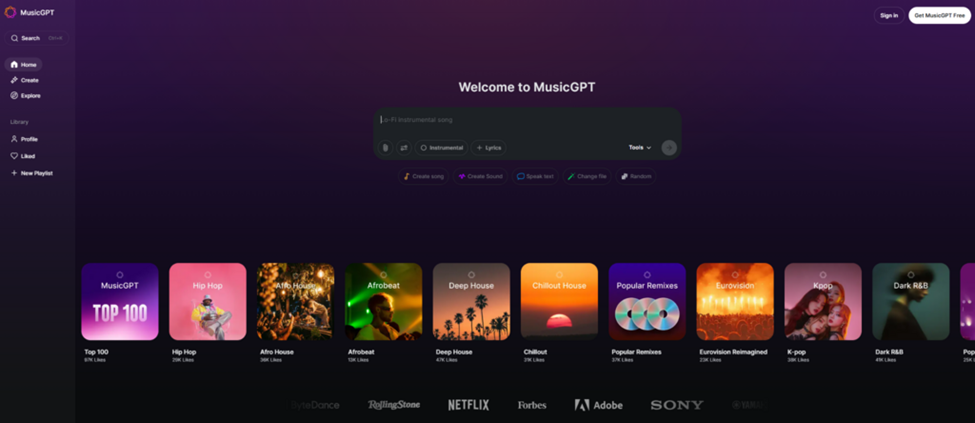
MusicGPT approaches AI music generation with a more experimental framework. Inspired by text-generation models, the platform uses prompts and structured instructions to produce audio pieces that reflect user input.
Instead of focusing only on quick music creation, the tool often emphasizes creative exploration. Users can try unusual genre combinations, mood descriptions, or narrative prompts to see how the AI interprets them.
This makes MusicGPT interesting for creators who want to push beyond conventional music generation workflows.
Ideal Users
MusicGPT tends to attract:
● AI enthusiasts exploring generative creativity
● Experimental musicians testing AI-assisted composition
● Researchers studying generative audio systems
● Digital artists incorporating sound into multimedia projects
While beginners can still use it, its experimentation-driven design may appeal most to users curious about AI’s creative potential.
How It Works
A typical workflow looks like this:
Visit the MusicGPT website.
Write a prompt describing the desired song style.
Submit the prompt to generate music.
Review the generated audio.
Refine the prompt and regenerate if needed.
The iterative process encourages users to explore different musical possibilities.
4. MusicCreator AI
Overview
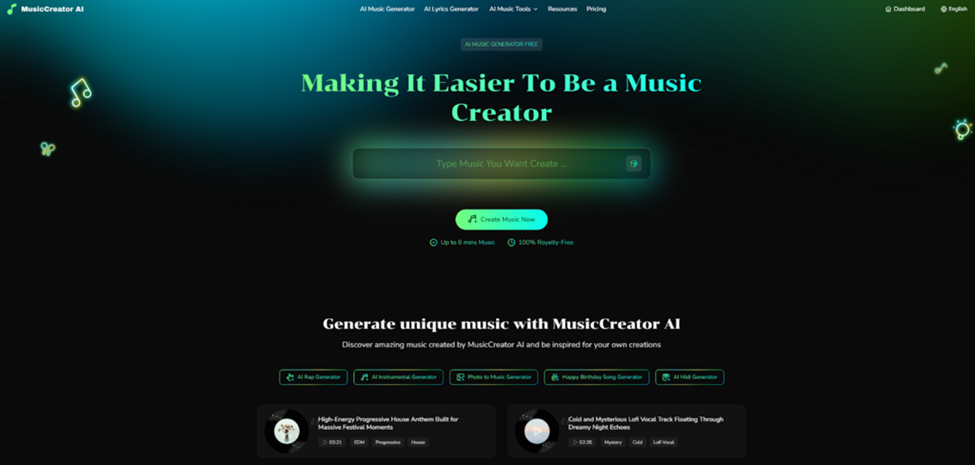
MusicCreator AI is built around the concept of helping users produce custom music tracks for media projects. The platform combines AI-driven composition with practical tools designed for content production.
Instead of focusing solely on novelty, the system emphasizes usability for creators who need functional music assets. This can include background scores, ambient soundtracks, or short audio loops.
Ideal Users
The platform is well suited for:
● Video editors needing quick music for edits
● Advertising teams creating promotional audio
● Mobile app developers looking for simple soundtracks
● Freelancers producing multimedia content
Because it focuses on production-friendly outputs, it’s particularly helpful in content workflows.
How It Works
Typical steps include:
Access the MusicCreator AI website.
Select the music style or project type.
Provide prompts or parameters.
Generate the track.
Export the audio file for use in your project.
The interface aims to reduce friction between idea and finished audio asset.
5. MusicGeneratorAI

Overview
MusicGeneratorAI offers another option for users looking to create music using AI directly in their browser. The platform focuses on automated music generation through descriptive prompts and genre selections.
Its outputs typically lean toward instrumental pieces that can serve as background audio for various types of media.
While the platform may not include advanced editing tools, its straightforward design allows users to generate music quickly.
Ideal Users
MusicGeneratorAI can be useful for:
● Beginner creators exploring AI music tools
● Students experimenting with generative music
● Small businesses needing simple background tracks
● Social media creators who want quick music options
How It Works
The basic workflow includes:
Go to the MusicGeneratorAI website.
Describe the desired style or mood
Generate the music track.
Preview and download the result.
Like many AI generators, the process revolves around prompt-based creativity.
Final Thoughts
The rise of AI-powered music tools has dramatically lowered the barrier to entry for music creation. With an AI Music Generator Online, anyone can transform a simple idea into a complete track within minutes. These platforms are helping creators prototype soundtracks, generate background music, and experiment with new musical styles faster than ever.
Among the tools discussed above, each offers its own strengths—from experimental prompt-driven systems to practical media-focused generators. However, for users who want a balanced combination of accessibility, speed, and creative flexibility, platforms that function as both an AI Music Generator Online and a capable AI Song Generator tend to stand out.
In particular, tools like MakeSong provide a surprisingly smooth experience for turning text prompts into full songs. For creators who want a simple yet powerful way to explore AI-generated music, it’s definitely a platform worth keeping on the radar as the AI music landscape continues to evolve.


Comments