
DreamGen vs Character.AI Privacy Comparison: 7 Critical Data Protection Gaps


AI role-play chatbots exploded last year, but are your private stories really private? DreamGen -- an AI platform that combines a scenario codex, multi-character role-play, and a story-writing mode -- pitches a privacy-first design, while Character.AI faces criticism for harvesting chats.
This guide breaks down seven data-protection gaps, from model-training consent to breach history, so you can decide which companion deserves your trust.
DreamGen's privacy-first design vs. Character.AI's data grab
Picture two restaurants. One streams its kitchen so you can watch every dish come together. The other keeps the door locked and asks you to trust the chef. That contrast captures the difference between DreamGen and Character.AI.

DreamGen's founders built the platform around a single promise: your imagination stays yours. The site spells that out in plain language and backs it up with product choices. The platform collects only the minimum: an email address and, for premium plans, payment details. Some of the base model architectures DreamGen builds on are open-weight, inviting outside scrutiny of the underlying technology.
Character.AI chooses the closed route. Its code is private, its moderation stack opaque, and you never know exactly what happens to the words you type. That opacity forces users to gamble on corporate goodwill rather than proven safeguards.
Transparency shapes culture. Because DreamGen assumes every line of code may be read, it collects only the minimum: an email address and, for premium plans, payment details. Character.AI starts with maximal data collection and pares back only under backlash.
When a product's design philosophy respects privacy, every downstream policy tends to follow. That is why this first gap matters; it sets the tone for everything that follows.
Model training: opt-in versus auto-harvest
Every line you type is valuable to an AI developer. The question is whether you agree to hand it over.
DreamGen lets you decide. By default the platform keeps role-play logs out of its training pipeline. Only if you flip an explicit toggle does your story feed the models. DreamGen's privacy policy on https://dreamgen.com says, "With your consent, we may use your data… to train, evaluate and generally improve our AI models."
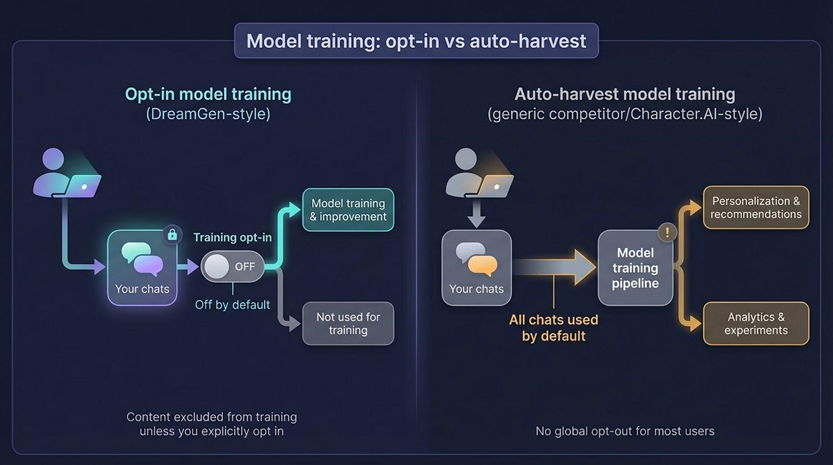
Turn that switch off again and the flow stops. DreamGen promises to stop using any deleted or withdrawn content within ninety days, so you keep control without losing features.
Character.AI takes the opposite stance. Open a chat and the system automatically absorbs every message to refine future versions of the model. There is no global opt-out for most users, so the only real escape is to stop chatting. Your poems, private vents, and spicy fantasies become permanent seasoning in Character.AI's secret sauce.
Why does it matter? Creative content often carries personal details and emotion. An opt-in policy treats that context as yours; an auto-harvest policy treats it as fuel. The difference is consent in action, one click versus none.
Data retention and deletion: 90-day purge versus forever logs
Hitting delete feels final, and on DreamGen it nearly is. You can wipe a single storyline or your entire account in a couple of clicks. Behind the scenes, the company queues that data for removal and states it will disappear from active systems within about three months. DreamGen's privacy policy (updated June 25 2024) puts that promise in writing: "We will cease using any content removed from our services within 90 days to the extent that this is technically feasible." Backups age out next, and DreamGen stops using deleted text in any capacity.

Character.AI takes a different path. Its policy keeps conversation records for "as long as necessary," a phrase that often means forever. Even if you scrub a chat from your dashboard, it likely still lives in server snapshots, analytics pipelines, and the weights of a continually trained model. The platform sets no firm retention limit and offers no guarantee that erased messages stop shaping future AI behavior.
That gap became a flashpoint during the #DeleteCharacterAI revolt in 2025, when users learned their most personal role-plays could linger indefinitely. DreamGen avoided that backlash by building time-bound deletion into the system from day one.
The takeaway is simple: if you want the option to make a clean exit, whether tomorrow or ten years from now, DreamGen hands you the broom. Character.AI hands you a suggestion box.
Third-party sharing: privacy versus profit
Who else sees your chats? The answer separates a service that works for you from one that works for advertisers.
DreamGen keeps the circle tight. Its policy lists only cloud hosts, payment processors, and other service providers needed for core operations—no ad networks or data-sale schemes. Vendors sign contracts that limit data use to the tasks DreamGen specifies, period.

Character.AI takes a broader view. The company notes that it may disclose personal information to advertising and analytics providers to enable tailored ads, along with affiliates and marketing vendors. In plain terms, your role-play logs can fuel ad targeting and campaign measurement across the web.
That divergence shapes incentives. DreamGen earns revenue from subscriptions, so respecting privacy aligns with its business model. Character.AI sells attention; sharing behavioral data with ad-tech partners is part of the playbook.
If you want a platform where your words serve only your story, choose the closed circle. If you stay on Character.AI, remember that your creative sparks may double as marketing pixels.
Content moderation: heavy surveillance versus creative freedom
Narrative interruptions break immersion, so moderation style matters. Character.AI scans each line against an evolving blacklist. Drift into tense romance, gritty language, or darker plots and the bot cuts the scene.

DreamGen takes a different approach. The platform's scenario codex and multi-character tools are designed for deep, extended storytelling. Because sessions often span hours and involve complex plot threads, the platform avoids mid-scene refusals. Outside of clearly illegal material, conversations flow without interruption, and we did not encounter filter-related breaks during testing.
Why does this matter for privacy? Constant scanning creates logs. Every flagged message is stored, reviewed, and sometimes escalated to human moderators. Fewer triggers mean fewer human reviews and less residual metadata.
Users notice the gap. Reddit threads often read, "I spent half the night battling Character.AI's filter," while others praise DreamGen for letting sessions flow uninterrupted. Smooth storytelling supports immersion, and immersion is the reason we are here.
In short, one platform polices you at the sentence level; the other lets you write the novel you came to write.
Human review: no peeking versus possible oversight
Inside every cloud service, an engineer can access the database. The real question is whether policy allows them to look.
DreamGen answers no. The policy states that staff never open private chats unless you grant permission, such as when you file a support ticket. Routine moderation relies on automated signals, not curious humans scrolling through your fantasies. Fewer eyes mean fewer nightmares.

Character.AI keeps the door ajar. Messages that trigger safety filters can be escalated for manual inspection, and the company reserves broad rights to review content to enforce its terms. Most of the time no one is watching, yet high-risk flags and past leaks—the 2025 "Adrian" incident comes to mind—remind users that someone might be.
Trust flows from clarity. DreamGen removes doubt by removing staff access. Character.AI asks you to trust unseen safeguards. If knowing a real person could read your most intimate storyline makes you uneasy, choose the platform that closes the blinds.
Security and breach history: clean slate versus headline breach
Encryption slogans look good on a landing page, but real-world incidents tell the truth.
DreamGen's record is quiet in the best way. As of early 2026, no public reports of leaks, credential dumps, or misconfigured buckets exist. Smaller scale helps because fewer moving parts mean fewer cracks to exploit. Open-weight base architectures invite white-hat scrutiny, so bugs surface early and quietly.
According to TechCrunch, a May 2025 partner-storage mishap at Character.AI exposed 2.3 million chat snippets, usernames, and timestamps to the open internet. Security blogs lit up, users panicked, and regulators asked questions. The company patched the hole, yet the episode confirmed what critics feared: one centralized trove of intimate chats offers an attractive prize for attackers.

Architecture matters here, too. DreamGen's openness lets power users run compatible models locally inside tools like SillyTavern, keeping conversations off any shared server. Character.AI offers no such escape; everyone's data flows into a single backend, convenient for engineers but tempting for intruders.
Judge platforms by the worst day on their security timeline. DreamGen's calendar is still blank; Character.AI's carries a date you cannot ignore.
Privacy features at a glance
We've covered a lot of ground, so here is a side-by-side snapshot. Use this table as a cheat sheet when you decide where to launch a new character or draft a private novella.
Privacy factor | DreamGen | Quick takeaway | |
Model training | Opt-in only | Automatic, no opt-out | Consent versus assumption |
Data retention | User-deleted data purged within 90 days | Indefinite server and model storage | One platform enables a clean exit |
Third-party sharing | Essential service providers only | Ad tech, analytics, affiliates | Your words or their revenue stream |
Content moderation | Light, reactive | Heavy, proactive filters | Create freely or battle blocks |
Human review | Forbidden without user request | Allowed for flagged content | Closed blinds versus cracked door |
Security record | Zero known breaches (2026) | 2025 leak of 2.3 million chats | Clean slate versus proven risk |
Self-hosting option | Compatible open-weight models | No, closed cloud only | Do-it-yourself privacy |
Conclusion
DreamGen and Character.AI sit at opposite ends of the privacy spectrum. DreamGen's opt-in data use, time-bound deletion, and minimal collection give users tangible control. For writers who also value the platform's scenario codex, multi-character support, and full message editing -- capabilities covered in detail on https://dreamgen.com -- the privacy design adds another reason to choose it. Character.AI's default data harvesting, indefinite retention, and documented breach ask users to trade privacy for convenience. If protecting intimate role-plays is your priority, the safer bet is clear.





Comments